
7 Minutes and Counting

Stop-WatchToday, we continue talking about Nelson Searcy’s book Fusion: Turning First-Time Guests into Fully-Engaged Members of Your Church. Searcy titled chapter 3, Seven Minutes and Counting. In the chapter, he talked the importance of what happens to first-time guests during the first 7 minutes of their visit. He wrote,


Seven minutes is all you get to make a positive first impression. In the first 7 minutes of contact with your church, your first-time guests will know whether or not they are coming back. That’s before a single worship song is sung and before a single word of the message is uttered.

Common sense tells us that we never get a second chance to make a first impression, and unfortunately, first impressions are usually lasting impressions. If Searcy is correct in saying that guests are deciding whether they are coming back in the first 7 minutes, then the question becomes, “what’s actually being judged?”

Are they judging the building, the landscaping, the parking lot, the church sign, the entrance area, the lobby, the parking lot greeters, the door greeters, the bulletin? The simple answer is “YES“! They probably judge all those things, but keep in mind, they decide if they are coming back before they sing the first song or hear a word of the sermon.

As pastors, we usually spend a large portion of our week planning the worship service and preparing the message without being proactive in this important area. We should continue our practice of sermon preparation, but we should also give thought, time, and attention to helping our guests have a great first impression. As pastors, we should take the lead in this area.

In my next post, I will look at the 7-minute, first impression time Searcy refers to as the time “from the street to the seat.” Here are my other posts along these lines.

The Key to Keep Church Guests Coming Back

fallsemester_serve2Let’s continue to look at Nelson Searcy’s rockin’ assimilation book, Fusion: Turning First-Time Guests into Fully-Engaged Members of Your Church. Today, we will look at God’s assimilation plan discussed in chapter 2.

But before we get into our discussion, let me encourage you to check out his blog and the free stuff that he is providing to help churches in their work for the Lord. Here are some helpful links to his website:

. . . . Now, on with the discussion. In chapter 2, Searcy wrote,

God has not only given us the responsibility of being hospitable to His guests, but He has also given us the perfect example of how to go about it. Jesus came to the earth to serve, not to be served. Throughout the New Testament, we see His examples of selfless service for those He had the opportunity to influence. And we’ve been left with the challenge of doing even greater things. When we serve our guests well, we reflect Jesus’ attitude and mindset toward them.

Although Searcy provided a thorough definition of assimilation in chapter 1, he sums up assimilation here as follows:

Assimilation is simply well-planned biblical hospitality through service. The head of our organization is the greatest server of all time. Doesn’t it follow that we should be the ultimate example of such service to our guests? With the right system in place, we can serve in a way that will truly touch lives for God’s kingdom.

For more details about  improving assimilation in your church, see the following posts:

The 3-Minute Rule

stopwatchAny church can immediately become more effective by practicing a simple little rule each time they gather for worship.  I call this rule the 3-Minute Rule. It’s simple, and it ONLY takes three minutes.

Here’s how the 3-Minute Rule works. Immediately after the morning worship service ends, all the regular attenders spend the first 3 minutes talking with guests, newcomers, or simply people they do not know, before they begin talking with their friends. If possible, they introduce those they meet during the 3-Minute time to their friends with the hope of including them in the group. This intentional approach would greatly improve “first impressions” of the church and assist with the assimilation of newcomers. We should always keep in mind that . . . .

We are a culture craving relationship. In the midst of our crowded existence, many of us are living lonely lives. We live and work in a sea of humanity, but we end up missing out on the benefits of regular, meaningful relationships.  (Andy Stanley)

I think we should practice a similar rule before the service as well. I call it the 2-Person Rule. Strive to meet at least two new people before the service begins. Imagine how many people you would meet after a few weeks. Remember . . . .

People are not merely looking for a friendly church; they are looking to make friends at church.  (Steve Rice)

It’s true that worship can be a time of personal reflection and adoration for the Lord, but it can also be a place of service. Make an effort this Sunday to meet at least two new people before the service and then take the first three minutes after the service to venture outside your normal conversation circle.  You’ll be blessed and you be a blessing to others as well!

Plow Horses & Dogs?

I agree with Dr. Gary L. McIntosh, that every church and every church leader needs to refocus from time to time! Every church needs to ask, “What sets us apart from other churches? What can our church offer to the community that is uniquely us?”

The truth is, that may be easier said than done. How can a church refocus? How can a church determine which ministries are unique to them? McIntosh says that it is helpful to categorize all the ministries of your church into one of four areas.

4 Ministry Categories

STARS: Stars refers to the most fruitful ministries–that is, the ministries that are responsible for bringing in the most new people or reaching the most people for Christ.

PUZZLES: This category includes the ministries that appear to be good but are not producing the results you think they should.

PLOW HORSES: The most popular ministries that do not result in many new people coming to Christ or to your church but which you must keep go in this category.

DOGS: The ministries that are draining your church of resources and produce almost no results go here. The church must deal with these ministries by retooling them, reinventing them, or by replacing them with stars.

McIntosh says that some churches find that they have zero stars. If that is the case, the church should focus on starting one new ministry each year for the next 5 years because new ministries tend to reach new people. Programs and ministries become less effective with age. New ministries are the most fruitful.

For more information about Church Revitalization, see the following posts:

Please contact the Church Consulting & Revitalization Team at the Kentucky Baptist Convention if we can help your church in any way.

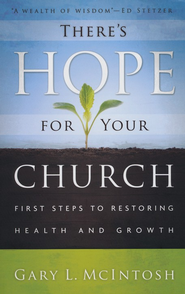
There’s Hope for Your Church

Gary L. McIntosh recently published a helpful book aimed at Church Revitalization called There’s Hope for Your Church. In his usual style, Dr. McIntosh provides practical, realistic coaching advice for pastors who are embracing the difficult task of helping one of the 75% of American churches that are plateaued or declining. In the next few posts, I’m going to share some of the key teachings from the Dr. McIntosh’s book.

Chapter 1 – See the Potential

If you are currently serving as a pastor in one of the 75% of churches that is on a long-term plateau or declining, THERE IS HOPE! There is hope for renewal, hope for growth, hope for new life! Dr. McIntosh says that there are at least three key reasons for such hope.

3 Reasons There is Hope for Your Church

1.  God wants your church to grow. The first mention of the church in the Bible contains God’s promise that his church will grow: “I also say to you that you are Peter, and upon this rock I will build My church; and the gates of Hades will not overpower it” (Matthew 16:18). Today there are approximately two billion Christians in the world. Compared to the small band of believers that met together in the upper room in Acts 1, the world-wide church makes it clear that Christ’s church has grown. God has kept his promise. God wants your church to be fruitful and multiply as well. Acts 12:24 reports that “the word of the Lord continued to grow and to be multiplied.” God wants his church to grow and multiply across the world as new believers accept the gospel of salvation in Jesus Christ.

2.  God revitalizes & restores churches. The New Testament records several beautiful pictures of restoration, such as the return of the prodigal son in Luke 15 and the call to the church in Revelation 2 & 3. The implication in Revelation is that God will restore churches that hear and repent.

3.  God is revitalizing churches right now. Dr. McIntosh points out that for the last three decades he has observed churches throughout the United States and Canada being renewed and revitalized. As a Kentucky Baptist pastor for over 23 years, I have been privileged to lead three churches to varying levels of revitalization. I have also been amazed to observe other pastors do so as well.

In a recent Western Recorder article, I read the amazing revitalization story of the Hillvue Heights Church in Bowling Green, Kentucky where Dr. Steve Ayers serves as Senior Pastor. When he came to the church, only a handful of people remained. Under his 21 years of leadership, the church has baptized over 7,000 new believers and grown to an average weekly attendance of 4,000. Although Hillvue’s story is not typical, it is a vivid testimony that THERE IS HOPE FOR YOUR CHURCH!