3 Ways to Resolve Conflict

conflict-620x230

Now all things are of God, who has reconciled us to Himself through Jesus Christ, and has given us the ministry of reconciliation. 2 Corinthians 5:18 (NKJV)

According to Scripture, Christians are called to a higher standard when it comes resolving conflict. Because we are reconciled to God through Christ, God requires every Christian to serve in the ministry of reconciliation. It is not optional and it is not up for discussion.

In my role I often talk to pastors and churches who are experiencing varying levels of conflict. The key to resolving conflict is to catch it early, in its infancy. A camp fire is much easier to extinguish than an inferno. This is especially true when it comes to conflict.

A camp fire is much easier to extinguish than an inferno!

Peacemaker Ministries has produced a number of good resources in this area. In their pamphlet Peacemaking Principles, they offer the following three biblical ways to resolve conflict early when it is still personal and private:

3 Way to Resolve Conflict

1.  Overlook an offense. Many disputes are so insignificant that they should be resolved by quietly overlooking an offense. “A man’s wisdom gives him patience; it is to his glory to overlook an offense” (Proverbs 19:11). Overlooking an offense is a form of forgiveness, and involves a deliberate decision not to talk about it, dwell on it, or let it grow into pent-up bitterness or anger.

2.  Reconciliation. If an offense is too serious to overlook or has damaged our relationship, we need to resolve personal or relational issues through confession, loving correction, and forgiveness. “If your brother has something against you…go and be reconciled” (Matthew 5:23-24). “Brothers, if someone is caught in a sin, you who are spiritual should restore him gently” (Galatians 6:1). “Forgive as the Lord forgave you” (Colossians 3:13).

3.  Negotiation. Even if we successfully resolve relational issues, we may still need to work through material issues related to money, property, or other rights. This should be done through a cooperative bargaining process in which you and the other person seek to reach a settlement that satisfies the legitimate needs of each side. “Each of you should look not only to your own interests, but also to the interests of others” (Philippians 2:4).

I have not always known or practiced these principles in my personal life or in my ministry, but I am now committed to do so. May we all seek to live by the Apostle Paul’s charge to the Christians in the church at Rome.

If possible, so far as it depends on you, live peaceably with all. Romans 12:18

5 Things I Hated Doing as a Pastor

In similar posts I wrote about 6 Things I Hated Hearing as a Pastor followed by 7 Things I Loved Hearing as a Pastor. In today’s post I want to explore 5 Things I Hated DOING as a Pastor. Keep in mind that I loved being a pastor and I loved most the tasks that came along with the position, but I didn’t love everything.

5 Things I Hated Doing as a Pastor

1. Preaching on difficult topics. I preached on marriage, divorce, homosexuality, fornication, adultery, abortion, tithing, racism, prejudice, laziness, gossip, and numerous other difficult subjects, but I didn’t love doing it. As a pastor, I preferred to preach about Jesus and the encouraging passages that abound, but I knew that I was accountable to God to preach the whole Bible even when the topics were not popular or culturally acceptable.

…even when the topics were not popular or culturally acceptable.”

2. Visiting new parents in the hospital. I didn’t really hate visiting new parents, but it always felt a little awkward. I felt better visiting when the mother and the father were both present or when my wife could join me. As their pastor, I wanted to let them know that we celebrated with them on the birth of their child, but at the same time, I wanted to respect their need for privacy. As a man, I was certain that I didn’t understand everything that the new mother was going through physically and emotionally, so I wanted to give her space for rest and healing.

3. Addressing church conflict. When I faced conflict during my early years of ministry I simply prayed and hoped that it would go away. As the pastor, I began to realize that I had to lean into conflict and work towards reconciliation, but it was something that I always dreaded.

…I began to realize that I had to lean into conflict…”

4. Asking for help. In the perfect church world, all the church members would jump in and volunteer when needed. Since that rarely happened, I often had to personally ask people for help.

5. Administering church discipline. The Bible clearly teaches that there are times when church discipline is required. The purpose of discipline is to help the offender discover his sin and his need for repentance. Even when church discipline was appropriate and best, it was always very difficult.

Similar Posts:

Lead to Revitalize – Part 2 (Revitalization Series)

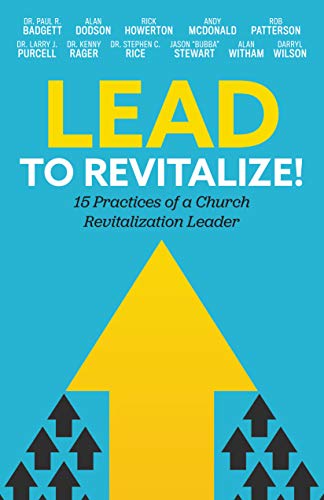
In the post, Lead to Revitalize – Part 1, we looked at the first 5 characteristics possessed by pastors who lead churches to experience significant revitalization and health. In this post, we will look at 5 additional characteristics. These 10 characteristics are listed in random order and all are equally important. We developed resources on this topic in our book entitled Lead to Revitalize: 15 Practices of a Revitalization Leader

10 CHARACTERISTICS OF A REVITALIZATION PASTOR

6.  Revitalization pastors demonstrate dependence on God.  This should not surprise anyone! The Scriptures clearly teach our need for the Holy Spirit’s power in our lives. Revitalization pastors seem to understand this fully because they consistently spend time with God in Bible reading and prayer, they often cry out to God for His blessing on the ministries of the church, and they lead the church to give God the glory when they experience a spiritual “win” as a congregation.

7.  Revitalization pastors are Lifelong Learners.  You’ve heard the saying “leaders are readers.” We would add the saying “revitalization pastors are lifelong learners.” Even those who are not avid readers find other ways to learn. They often listen to other pastor’s sermons, attend conferences, participate in state convention growth opportunities, and meet with other pastors to learn best practices.

8.  Revitalization pastors develop leaders and laborers in the church.  Revitalization pastors agree with the Apostle Paul that one of the main roles of a pastor is “to equip the saints for the work of ministry, for building up the body of Christ” (Ephesians 4:12, ESV). As a result, they develop a leadership development strategy for the church, regularly delegate ministry responsibilities to trusted people, and personally mentor a group of men in the congregation.

9.  Revitalization pastors lead the church to celebrate wins.  They celebrate wins by showing appreciation to church volunteers who serve faithfully. They sometimes ask for testimonies of where people recently saw God at work. They regularly focus on positive things that happen in the life of the church.

10.  Revitalization pastors lead the church to implement change.  Revitalization pastors spent time thoroughly explaining the reason behind a needed change and invested extra time with people who were slow to accept a needed change. They bathed proposed changes in significant prayer and resisted moving too quickly when making a major change.

Revitalization pastors come in all shapes and sizes, but they share these characteristics. There is a desperate need for Godly leadership in the local church. It is not enough for a pastor to develop a vision for revitalization, but he must LEAD the people to fulfill that vision. In many cases, it takes years to see stagnant churches become vibrant and healthy, so revitalization pastors tend to have longer tenures. Many studies show a relationship between pastoral tenure and church health.

Lead to Revitalize – Part 1 (Revitalization Series)

Over the past few years, the Regional Consultants of the Church Consulting and Revitalization Team and I noticed that pastors who successfully led their churches to experience revitalization possessed consistent characteristics. We developed resources on this topic and recently wrote a book entitled Lead to Revitalize: 15 Practices of a Revitalization Leader. The list only scratches the surface, but these ten characteristics stand out to us. I will detail these in a two-part blog post. Here is part one:

10 CHARACTERISTICS OF A REVITALIZATION PASTOR

1.  Revitalization pastors lean into conflict.  Some pastors avoid conflict at all costs. They may develop a brilliant, God-given vision for the future of the church, but they scrap it just as soon as one or two people are critical. Revitalization pastors do not necessarily like conflict, but they are willing to face it in order to fulfill the God-given vision.

2.  Revitalization pastors are willing to take risks. It’s risky to help a church understand that they are being ineffective. It’s rarely pleasant to confront difficult people or to seek restoration of a broken relationship, but revitalization pastors do what’s right instead of merely doing what’s easy and convenient.

3.  Revitalization pastors work hard on church relationships. As a child, most of us learned the little hand visual that accompanied the saying “here is the church, here is the steeple, open the door and here are the people.” As adults, we know that the symbolism is lacking because the church is not a building; the church IS the people. Revitalization pastors understand that building a church means building people.

4.  Revitalization pastors take the lead in evangelism. A church cannot be revitalized without reaching new people with the Gospel. A revitalization pastor places emphasis on evangelism and leads by example in this area. Methods of evangelism vary from church to church and community to community, but churches experiencing revitalization are making new converts for Christ.

5.  Revitalization pastors lead with a vision. Visions are sometimes written, sometimes spoken, and sometimes written and spoken! Revitalization pastors have a God-given vision for the church’s future and they share it regularly with the church.

For more information please contact me.

Click on image to purchase a copy of Lead to Revitalize.

KEYs to Revitalization (Revitalization Series)

Key

Dr. Gary L. McIntosh published an excellent book aimed at Church Revitalization called There’s Hope for Your Church. In the book, he examines the irreplaceable role that pastoral leadership plays when it comes to church revitalization. I agree with Dr. McIntosh when he says….

“In order for a church to be revitalized, the pastor is the key!”

2 Keys to Revitalization

1. Leadership. In chapter two, McIntosh discusses consultant Ken Priddy’s belief that two types of pastors exist: a revitalization pastor and a revitalization leader. A revitalization pastor sees the church as his client while the revitalization leader sees God as his client. A revitalization pastor views himself as an employee of the church while a revitalization leader sees himself as being called by God to lead the church where God wants it to go. Revitalization leaders expect to encounter resistance and are willing to lead without affirmation and often with pain.

“For churches to transition into a new era of ministry, courageous, godly leadership is paramount.”  Terry Walling

2. Longevity. One of the main reasons most pastors are not successful in bringing about revitalization is that they simply don’t stay long enough. The average tenure of a senior or solo pastor in the United States is 3.8 years. McIntosh says that it takes 5-7 years to revitalize a church in the city and 10-12 years to revitalize a rural church. The bottom line is that revitalization leaders stay!

The average tenure of a senior or solo pastor in the United States is 3.8 years . . . The bottom line is that revitalization leaders stay!

McIntosh warns that it is possible for a pastor to stay too long. In his experience, if the church has not experienced revitalization within 10-12 years of the pastor’s tenure, it is not going to happen. Although there are exceptions, the average pastor’s ministry tends to lose momentum after 10 years. After 10 years, the original vision the pastor had for the church has most likely been accomplished, and then the church flounders, searching for a new direction. Some pastors are able to re-envision their life and ministry for another 10 years in the same church, but some cannot and find it best to move to another ministry.