Easter Guest Follow-Up

Guest Follow-upThis Sunday your church will probably experience the largest weekly attendance of the year.  As you prepare for the Easter crowd, remember there is one KEY ingredient for effective follow-up to take place–you must get the CONTACT INFORMATION of your guests!  The only way for an effective follow-up system to work is to have a way to communicate with guests the following week.  Here are some tips for obtaining the contact information from your guests.

How to Obtain Contact Information from Your Guests

1.  Guest parking.  Save the best, most visible parking spots for guests.  The guest parking spots should be near the desired guest entrance and parking lot greeters should be near the area where guests park.  Making a good first impression in the parking lot relaxes guests and increases the likelihood that they will share their contact information when asked to do so.

2.  Utilize good greeters.  Every church should utilize a greeter team.  Although the church may not need parking lot greeters in order to park cars, their presence is still vital.  They can cheerfully greet guests and members as well as answer questions as folks are entering the facility.  Greeters should be stationed at every outside entrance and greeters or ushers should be placed at all the entrances into the worship facility.  If the building is large, greeters should be scattered throughout areas of the building as well.

3.  Use a connection card in the worship guide.  There are lots of ways to obtain guest contact information, but one of the best ways is to insert a connection card in the worship guide.  A card that is attached to the worship guide is good, but it is noisy when someone tears off the perforated portion.  Some guests are hesitant to tear off the card because they do not want to attract attention.  When inserted in the worship guide, the connection card should be placed on fairly thick paper.  Cards can be printed three-to-a-page on standard 8.5 x 11-inch 70-lb. paper.  70-lb. paper is better than the thickest 110-lb. card-stock because it will not fall out of the worship guide as easily.  It is also good to have connection cards on the back of the pews or seats in case some guests do not get a copy of the worship guide as they enter the worship service.

4.  Ask for less; get more.  Most people ask for TOO MUCH INFORMATION on the connection card.  As a result, guests avoid filling out the card altogether and follow-up does not take place.  Ask for basic contact information such as name, address, email, best phone number, etc. Generally, when you ask for less information, you will get a higher rate of return from your guests.  It’s better to receive less information from your guest than to receive none at all.

5.  Recruit the right person to extend the welcome.  In many cases, guests are never even acknowledged during the worship service.  Of course, they should never be singled out or embarrassed, but it is helpful to acknowledge them and to thank them for coming.  The church should recruit a genuinely friendly person who is able to communicate in a comfortable, relaxed manner.  Many times the best person for this role is someone other than a staff member.  At some point during the service, this person can verbally welcome guests and ask them to complete the connection card. Encourage the guest to drop the completed connection card in the offering plate as it passes or to hand their card to an usher after the service.  It is best if the offering is taken up at the end of the service, so guests will have more time to gain confidence in the church leadership and more time to complete the information.

6.  Offer a gift to those who complete the connection card.  It is often helpful to offer a gift to those who complete the connection card.  One effective approach is to place copies of a small Christian book on tables by the exits in the worship center.  During the welcome time, guests can be told to pick up a copy of the book as they exit the service as a gift for completing the connection card.  The church should place a generous supply of books and allow guests to take them on their own.  That approach seems to say “since you are trusting us with your contact information we are trusting you with our stack of books.”  The church demonstrates a generous spirit with this approach.  Be sure to hide a letter inside each book that thanks the guest for coming and invites them to attend again in the near future.

These are not the only ways to obtain contact information from guests, but keep in mind, you MUST get the contact information from your guests in order to follow-up.  For more information along these lines, check out the following posts:

Churches Are Too Much Like Car Dealerships

The Chick-fil-A Church

The 3-minute Rule

How Can You Reach People for Jesus?

There are more than 7 billion people in the world today, and less than 20% know Jesus.  How can you reach them all with the life-giving message of the Gospel? Can your dollars reach from you to eternity? This video shows how through the Cooperative Program, mission dollars go from you, to your church, to the Kentucky Baptist Convention and around the world, powering missions and ministry every step along the way. This video would be excellent for use in worship services, Sunday School, and new members classes.

The 3-Minute Rule

stopwatchAny church can immediately become more effective by practicing a simple little rule each time they gather for worship.  I call this rule the 3-Minute Rule. It’s simple, and it ONLY takes three minutes.

Here’s how the 3-Minute Rule works. Immediately after the morning worship service ends, all the regular attenders spend the first 3 minutes talking with guests, newcomers, or simply people they do not know, before they begin talking with their friends. If possible, they introduce those they meet during the 3-Minute time to their friends with the hope of including them in the group. This intentional approach would greatly improve “first impressions” of the church and assist with the assimilation of newcomers. We should always keep in mind that . . . .

We are a culture craving relationship. In the midst of our crowded existence, many of us are living lonely lives. We live and work in a sea of humanity, but we end up missing out on the benefits of regular, meaningful relationships.  (Andy Stanley)

I think we should practice a similar rule before the service as well. I call it the 2-Person Rule. Strive to meet at least two new people before the service begins. Imagine how many people you would meet after a few weeks. Remember . . . .

People are not merely looking for a friendly church; they are looking to make friends at church.  (Steve Rice)

It’s true that worship can be a time of personal reflection and adoration for the Lord, but it can also be a place of service. Make an effort this Sunday to meet at least two new people before the service and then take the first three minutes after the service to venture outside your normal conversation circle.  You’ll be blessed and you be a blessing to others as well!

Plow Horses & Dogs?

I agree with Dr. Gary L. McIntosh, that every church and every church leader needs to refocus from time to time! Every church needs to ask, “What sets us apart from other churches? What can our church offer to the community that is uniquely us?”

The truth is, that may be easier said than done. How can a church refocus? How can a church determine which ministries are unique to them? McIntosh says that it is helpful to categorize all the ministries of your church into one of four areas.

4 Ministry Categories

STARS: Stars refers to the most fruitful ministries–that is, the ministries that are responsible for bringing in the most new people or reaching the most people for Christ.

PUZZLES: This category includes the ministries that appear to be good but are not producing the results you think they should.

PLOW HORSES: The most popular ministries that do not result in many new people coming to Christ or to your church but which you must keep go in this category.

DOGS: The ministries that are draining your church of resources and produce almost no results go here. The church must deal with these ministries by retooling them, reinventing them, or by replacing them with stars.

McIntosh says that some churches find that they have zero stars. If that is the case, the church should focus on starting one new ministry each year for the next 5 years because new ministries tend to reach new people. Programs and ministries become less effective with age. New ministries are the most fruitful.

For more information about Church Revitalization, see the following posts:

Please contact the Church Consulting & Revitalization Team at the Kentucky Baptist Convention if we can help your church in any way.

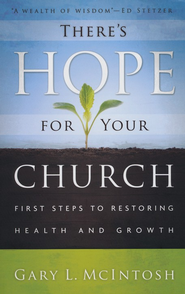
There’s Hope for Your Church

Gary L. McIntosh recently published a helpful book aimed at Church Revitalization called There’s Hope for Your Church. In his usual style, Dr. McIntosh provides practical, realistic coaching advice for pastors who are embracing the difficult task of helping one of the 75% of American churches that are plateaued or declining. In the next few posts, I’m going to share some of the key teachings from the Dr. McIntosh’s book.

Chapter 1 – See the Potential

If you are currently serving as a pastor in one of the 75% of churches that is on a long-term plateau or declining, THERE IS HOPE! There is hope for renewal, hope for growth, hope for new life! Dr. McIntosh says that there are at least three key reasons for such hope.

3 Reasons There is Hope for Your Church

1.  God wants your church to grow. The first mention of the church in the Bible contains God’s promise that his church will grow: “I also say to you that you are Peter, and upon this rock I will build My church; and the gates of Hades will not overpower it” (Matthew 16:18). Today there are approximately two billion Christians in the world. Compared to the small band of believers that met together in the upper room in Acts 1, the world-wide church makes it clear that Christ’s church has grown. God has kept his promise. God wants your church to be fruitful and multiply as well. Acts 12:24 reports that “the word of the Lord continued to grow and to be multiplied.” God wants his church to grow and multiply across the world as new believers accept the gospel of salvation in Jesus Christ.

2.  God revitalizes & restores churches. The New Testament records several beautiful pictures of restoration, such as the return of the prodigal son in Luke 15 and the call to the church in Revelation 2 & 3. The implication in Revelation is that God will restore churches that hear and repent.

3.  God is revitalizing churches right now. Dr. McIntosh points out that for the last three decades he has observed churches throughout the United States and Canada being renewed and revitalized. As a Kentucky Baptist pastor for over 23 years, I have been privileged to lead three churches to varying levels of revitalization. I have also been amazed to observe other pastors do so as well.

In a recent Western Recorder article, I read the amazing revitalization story of the Hillvue Heights Church in Bowling Green, Kentucky where Dr. Steve Ayers serves as Senior Pastor. When he came to the church, only a handful of people remained. Under his 21 years of leadership, the church has baptized over 7,000 new believers and grown to an average weekly attendance of 4,000. Although Hillvue’s story is not typical, it is a vivid testimony that THERE IS HOPE FOR YOUR CHURCH!