
One Circle at a Time

Churches often ask how they can reach their community and the world with the gospel? Programs have their place. Events can help. Strategies matter. But sometimes the most effective path forward is not something new—it is something faithful, simple, and biblical.

Oscar Thompson’s classic evangelism approach in Concentric Circles of Concern offers just that. Though written decades ago, its wisdom remains timely for Kentucky churches seeking to make a lasting impact both at home and abroad.

Thompson challenged believers to think relationally. Instead of beginning with strangers, he urged Christians to begin with the people God has already placed in their lives. He described a series of “concentric circles” that move outward from the individual believer:

The Power of the Circles

The principle is simple: evangelism flows naturally through relationships. Before we can expect to reach the world, we must first be faithful in our own circle.

1. The believer. Thompson insisted that evangelism begins with a vibrant personal walk with Christ. A cold heart will not produce a warm witness. Churches that want to reach their communities must first cultivate spiritual depth among their members. Prayer, repentance, and daily obedience are foundational. When believers walk closely with Christ, witnessing becomes less of a program and more of a natural overflow.

2. Immediate family. Scripture consistently teaches that faith begins in the home. Before we organize large outreach events, we should ask: Are we discipling our own households?

In Kentucky, where family ties run deep, this circle holds particular weight. When fathers and mothers live out their faith with integrity, children see the gospel modeled before it is ever explained. A church that equips families to share Christ at the dinner table is laying a foundation that will outlast any event on the calendar.

3. Extended family. Many Kentuckians have extended family networks that stretch across counties and even state lines. Thompson encouraged believers to list the names of relatives who need Christ and pray for them specifically.

4. Close friends. These are often the most fruitful gospel conversations because trust already exists. Holiday gatherings, ball games, and backyard cookouts can become divine appointments. When believers approach these relationships intentionally and prayerfully, the gospel spreads naturally.

5. Neighbors and associates. Every church sits in a community filled with people who may never walk through its doors unless someone personally invites them. Thompson’s strategy challenges churches to shift from attractional thinking to relational engagement. Instead of waiting for the community to come to us, we go to them—across the street, across the fence, across the office hallway.

Imagine if every member of a church identified five neighbors and committed to pray for them daily. Imagine if every Sunday School class made a list of coworkers represented in their group and began praying intentionally for open doors. Revival would not be a distant hope. KBC churches would experience much-needed revitalization.

6. Acquaintances. We encounter people every day in stores, restaurants, civic organizations, and ballfields. These brief connections may seem insignificant, but God often uses simple conversations to open eternal doors.

7. The world. The final circle he refers to as “person X.” “Person X” represents the world. Thompson taught that churches best reach the nations when their members are faithful in their immediate relationships. A congregation that cannot share Christ with its neighbors will struggle to sustain passion for the unreached. When local evangelism thrives, global missions flourish. Hearts stirred for the lost across the street will also beat for the lost across the ocean.

Personal Note. Praise the Lord, I have recently seen this play out in my family. Our daughter and son-in-law took the time to talk to their children about Christ and to take them regularly to church. Both sets of grandparents regular talked to them about the Gospel as well. As a result, our two oldest grandsons individually began to ask questions about following Christ. My son-in-law shared the Gospel with each of them privately and each of them accepted Christ as their Savior. Their pastor gave me the glorious privilege of baptizing each of them in the church where they attend. Thank You Lord for the power of the Gospel and for the opportunities You give us within our concentric circles.

The Chick-fil-A Church

Original Sandwich MobileThe average church could learn a lot from Chick-fil-A. Every time I drop by our local Chick-fil-A for lunch, I have a wonderful experience. Good food, great service, fair prices! Their mission statement is simple, “Be America’s Best Quick-Service Restaurant!” The founder, Truett Cathy, may well have fulfilled that statement.

THINGS THAT CHICK-FIL-A DOES RIGHT

  • Clean and neat. The restaurant is landscaped, clean, and bright. The atmosphere makes me comfortable and relaxed from the beginning.
  • Friendly, prompt service. The employees who take my order make eye contact, smile, welcome me, and process my order perfectly.
  • Generous. Before the pandemic, condiments were available at the condiment station and I was trusted to get the amount I needed. A whole basket of delicious mints were available for the taking. (Note: I only took one.)
  • Great product. Of course, the main reason I go to the restaurant is to eat. Their food is always hot, tasty, neatly packaged, and delivered with a smile.
  • Customer-oriented. Let me tell you what happened one day when I was there. After my meal, I walked to the counter to get a refill of their delicious sweet tea. At that particular moment everyone was busy, but a gentleman who was wiping off a table saw me, stopped what he was doing, quickly came up and said, “Sir, could I get you a refill.” I really don’t think it was his job to refill my tea, but he left what he was doing to serve a customer. After I thanked him, he said, “It’s my pleasure sir.” I’m sorry, but that was just flat impressive!

I’m not going to bother trying to make an application to the church because I think the application is obvious. I repeat, the average church could learn a lot from Chick-fil-A.

For more help with assimilation, see The 3-Minute Rule.

Lead to Revitalize – Part 2 (Revitalization Series)

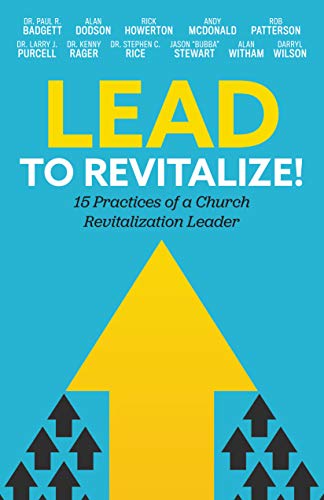
In the post, Lead to Revitalize – Part 1, we looked at the first 5 characteristics possessed by pastors who lead churches to experience significant revitalization and health. In this post, we will look at 5 additional characteristics. These 10 characteristics are listed in random order and all are equally important. We developed resources on this topic in our book entitled Lead to Revitalize: 15 Practices of a Revitalization Leader

10 CHARACTERISTICS OF A REVITALIZATION PASTOR

6.  Revitalization pastors demonstrate dependence on God.  This should not surprise anyone! The Scriptures clearly teach our need for the Holy Spirit’s power in our lives. Revitalization pastors seem to understand this fully because they consistently spend time with God in Bible reading and prayer, they often cry out to God for His blessing on the ministries of the church, and they lead the church to give God the glory when they experience a spiritual “win” as a congregation.

7.  Revitalization pastors are Lifelong Learners.  You’ve heard the saying “leaders are readers.” We would add the saying “revitalization pastors are lifelong learners.” Even those who are not avid readers find other ways to learn. They often listen to other pastor’s sermons, attend conferences, participate in state convention growth opportunities, and meet with other pastors to learn best practices.

8.  Revitalization pastors develop leaders and laborers in the church.  Revitalization pastors agree with the Apostle Paul that one of the main roles of a pastor is “to equip the saints for the work of ministry, for building up the body of Christ” (Ephesians 4:12, ESV). As a result, they develop a leadership development strategy for the church, regularly delegate ministry responsibilities to trusted people, and personally mentor a group of men in the congregation.

9.  Revitalization pastors lead the church to celebrate wins.  They celebrate wins by showing appreciation to church volunteers who serve faithfully. They sometimes ask for testimonies of where people recently saw God at work. They regularly focus on positive things that happen in the life of the church.

10.  Revitalization pastors lead the church to implement change.  Revitalization pastors spent time thoroughly explaining the reason behind a needed change and invested extra time with people who were slow to accept a needed change. They bathed proposed changes in significant prayer and resisted moving too quickly when making a major change.

Revitalization pastors come in all shapes and sizes, but they share these characteristics. There is a desperate need for Godly leadership in the local church. It is not enough for a pastor to develop a vision for revitalization, but he must LEAD the people to fulfill that vision. In many cases, it takes years to see stagnant churches become vibrant and healthy, so revitalization pastors tend to have longer tenures. Many studies show a relationship between pastoral tenure and church health.

Lead to Revitalize – Part 1 (Revitalization Series)

Over the past few years, the Regional Consultants of the Church Consulting and Revitalization Team and I noticed that pastors who successfully led their churches to experience revitalization possessed consistent characteristics. We developed resources on this topic and recently wrote a book entitled Lead to Revitalize: 15 Practices of a Revitalization Leader. The list only scratches the surface, but these ten characteristics stand out to us. I will detail these in a two-part blog post. Here is part one:

10 CHARACTERISTICS OF A REVITALIZATION PASTOR

1.  Revitalization pastors lean into conflict.  Some pastors avoid conflict at all costs. They may develop a brilliant, God-given vision for the future of the church, but they scrap it just as soon as one or two people are critical. Revitalization pastors do not necessarily like conflict, but they are willing to face it in order to fulfill the God-given vision.

2.  Revitalization pastors are willing to take risks. It’s risky to help a church understand that they are being ineffective. It’s rarely pleasant to confront difficult people or to seek restoration of a broken relationship, but revitalization pastors do what’s right instead of merely doing what’s easy and convenient.

3.  Revitalization pastors work hard on church relationships. As a child, most of us learned the little hand visual that accompanied the saying “here is the church, here is the steeple, open the door and here are the people.” As adults, we know that the symbolism is lacking because the church is not a building; the church IS the people. Revitalization pastors understand that building a church means building people.

4.  Revitalization pastors take the lead in evangelism. A church cannot be revitalized without reaching new people with the Gospel. A revitalization pastor places emphasis on evangelism and leads by example in this area. Methods of evangelism vary from church to church and community to community, but churches experiencing revitalization are making new converts for Christ.

5.  Revitalization pastors lead with a vision. Visions are sometimes written, sometimes spoken, and sometimes written and spoken! Revitalization pastors have a God-given vision for the church’s future and they share it regularly with the church.

For more information please contact me.

Click on image to purchase a copy of Lead to Revitalize.

Reboot or Rebuild the Church

When the pandemic began, most of us assumed that our churches would just bounce back to “normal” shortly after the Covid-19 restrictions lifted. Much like turning our internet modem off and then back on when we experience connection issues, we thought the church would simply “reboot.” But, a reboot has not happened and it may never happen.

LifeWay Research indicates that only 50-70% of pre-Covid attendees had returned to in-person church activities by August, 2021. According to researcher, Scott McConnell, “worship attendance is improving, but there is still a large gap between today’s in-person attendance and pre-COVID levels.” The percentage is higher when online participation is included, but those numbers are difficult to track. As we move forward, we will not be able to simply reboot; we will have to rebuild!

We will not be able to simply reboot; we will have to rebuild!

That’s easy to recognize, but how do we have a “rebuild” mindset? What does that even mean? Here are seven key elements of rebuilding.

7 Keys to Rebuild the Church

  1. Outreach. We must continue to reach out to those who have never attended our church. Many communities are growing and new prospects are moving in regularly. Even in non-growing communities, there are people who need Christ. Some of them are experiencing grief related to the pandemic and are more spiritually open than ever.
  2. In-reach. Don’t give up on members and former attendees who haven’t returned to church. Without being pushy or assigning blame, reach out to them. Help them take small steps back to church. Maintain safety measures for those who are at risk and/or have concerns related to their health.
  3. Ministry. Provide pastoral ministry to all church members. That’s fairly easy for those in attendance, but challenging for those who have not returned. If the church is small, you can print off the membership role and call a few members each day to check on them. When you call, ask if they have needs and prayer concerns. Write down what they share and pray for them over the phone. When you call them in future, check your notes and ask them about the things they shared on the last call. If the church is larger, you can share this ministry with the deacons, Sunday School teachers, or form a special phone team. A safe, personal touch matters more than ever!
  4. Assimilation. Be prepared when new people attend and others return. In addition to all the normal assimilation basics, give priority to cleanliness and safety. We will never just “go back to normal” after living through a pandemic. Masks, hand sanitizer, bleach, and personal space changes are here to stay.
  5. Creativity. Don’t pretend the pandemic is over. The truth is, long after it is over, it will not be “over.” Be creative in providing options in worship and other church ministries. Make sure that those who are extra cautious are made to feel welcome and treated with respect.
  6. Technology. Technology is not the Devil! We’ve learned so much about technology during the pandemic, and reached new people as a result. We should continue to improve and expand our use of technology, even as our in-person attendance increases.
  7. Focus. Specifically, focus on Jesus! People need Jesus! Preach Jesus! Sing about Jesus! Pray in Jesus’ name! Walk with Jesus! Love Jesus! Model Jesus! People need Jesus!

“…focus on Jesus! Preach Jesus! Sing about Jesus! Pray in Jesus’ name!…People need Jesus!”

Bonus Tip: Don’t give up!

“And let us not grow weary of doing good, for in due season we will reap, if we do not give up. So then, as we have opportunity, let us do good to everyone, and especially to those who are of the household of faith” (Galatians 6:9-10, ESV).